Start with the free option
The City of Brownsville collects brush free, so check that route before paying anyone. The program is delivered through Republic Services and divides the city into four sectors, serving one sector per week on a rotating monthly cycle. It accepts tree limbs, shrubs and bagged grass and leaves. Sector 3 is the area north of Boca Chica Boulevard and east of Paredes Line Road; Sector 4 is the area south of Boca Chica Boulevard and east of Expressway 77.
Three rules decide whether your pile actually gets taken. Material must be set out one week before your sector's collection week. Brush and bulky items must be in two separate piles, not mixed. And the pile must sit six feet clear of gas and water meters, telephone boxes, overhead wires, parked cars and overhangs, because the collection vehicle uses a grabber arm that needs room to work.
Miss any of those and the truck passes you by, usually without explanation, and you wait for the next rotation. The full breakdown of how the sectors and the timing work is on the Brownsville bulk and brush pickup schedule page.
When paying for removal is the right call
Paid brush removal makes sense in three situations, and outside them the city program is genuinely the better option. First, timing: if your sector was served last week, the next pass is roughly a month out. Second, exclusions: the program refuses dirt, bricks, concrete, asphalt, lumber, construction and demolition debris, liquids and hazardous waste, all of which turn up in real landscaping work. Third, volume: a whole-yard clearance or a tree removal produces more than a curbside pile is designed to hold.
The month-long wait is not a trivial inconvenience in this climate. Brush sitting on a Brownsville front yard through a wet week holds water, and standing water is a mosquito problem in a region where mosquito-borne disease control is an active public health matter. Rodents and snakes use brush piles as harbourage. On a narrow frontage, a month-old pile also blocks the sidewalk that children use to walk to school.
What brush removal costs in Brownsville
Brush and yard waste price by volume at roughly $1.50 per cubic foot, the same rate that applies to any junk load, which puts a quarter truck around $150 and a full truck at $450 to $850. The thing to understand about brush specifically is that it is bulky rather than heavy. Branches do not stack flat, palm fronds do not compact at all, and a pile that reads as modest on a lawn regularly fills more truck than the homeowner expected.
| Job | Typical load | Typical price |
|---|---|---|
| Single tree trimming | Quarter truck of limbs | $150 to $250 |
| Palm trimming, one to two trees | Quarter to half truck of fronds | $175 to $300 |
| Hedge and shrub removal | Half truck | $250 to $425 |
| Whole-yard clearance | Three-quarter to full truck | $375 to $700 |
| Tree removal aftermath | Full truck or more | $450 to $850 per load |
| Ground stump and chips | Weight-limited part load | $200 to $400 |
| Dug stump with root ball | Heavy, staged load | $350 to $650 |
| City sector collection | Accepted brush, separate pile, set out a week ahead | Free |
Volume bands follow the industry rate of roughly $1.50 per cubic foot with full-truck loads of $450 to $850, drawn from published national cost surveys; observed Brownsville-area job pricing has ranged from $102 to $612. Stump rows reflect that soil on a root ball converts a volume job into a weight-limited one. The free row is the City of Brownsville brush program delivered through Republic Services.
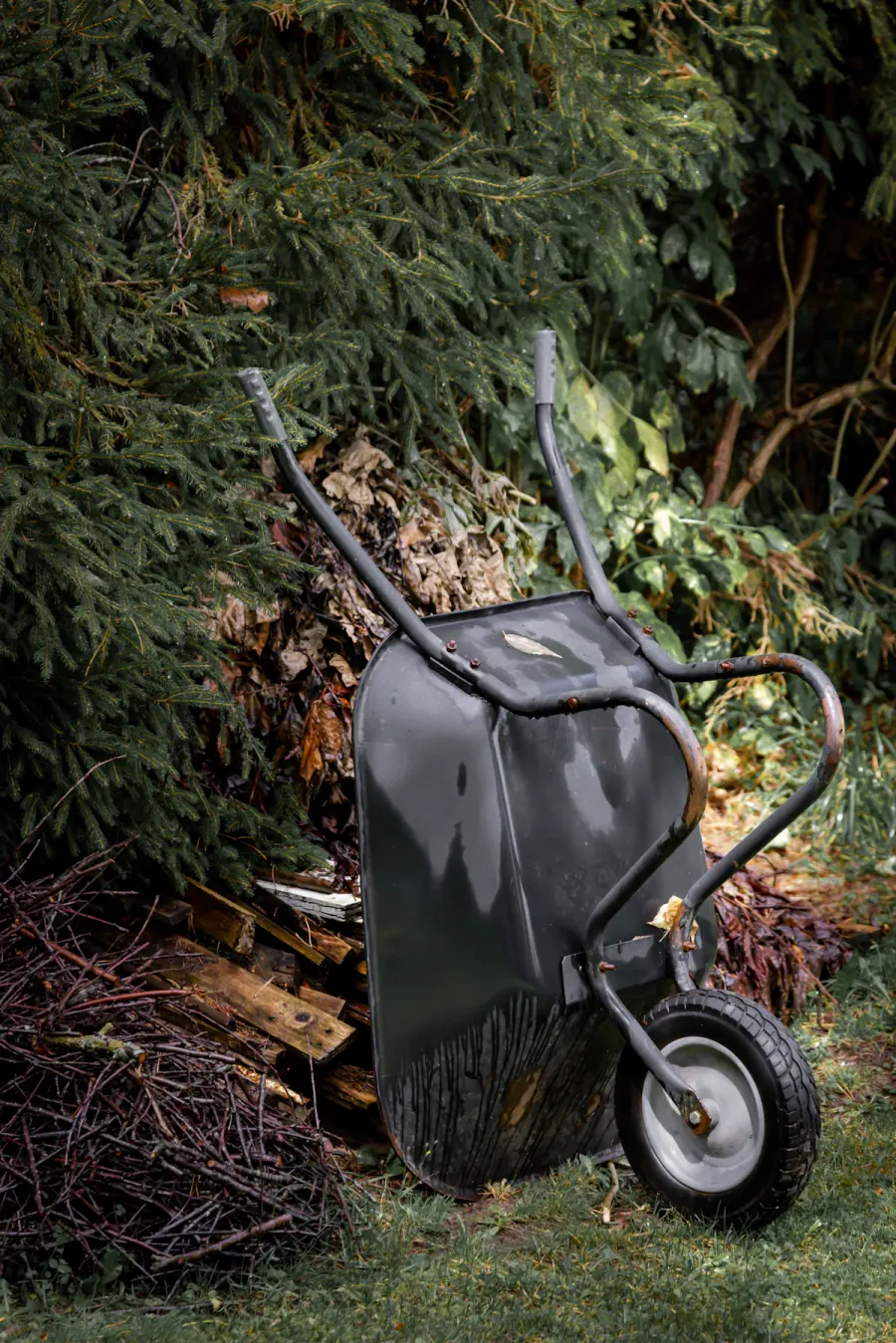
What a Rio Grande Valley yard actually produces
Palm fronds
Palms are the signature yard waste of the Valley and they behave differently to ordinary branches. Fronds are long, stiff and often spiny at the base, they resist compaction, and a single mature palm trimmed once can produce a load that surprises the homeowner. They are accepted brush under the city program, so the free route works if the timing does.
Mesquite, ebony and huisache
South Texas natives are dense and thorny, which makes them slower to handle than the volume suggests. Mesquite in particular is heavy for its size. Thorn load is the reason this material gets cut and loaded rather than dragged, and the reason it is a poor candidate for sitting on a curb beside a footpath for a week.
Grass, leaves and seasonal growth
A subtropical climate means growth does not stop for winter, so yard waste here is a year-round output rather than a spring and autumn one. Bagged grass and leaves are accepted by the city program. Where paid removal comes in is usually after a clearance, a re-landscaping job or a long absence rather than routine mowing.
Storm-dropped vegetation
Wind damage produces yard waste on a different scale and on a schedule nobody chose. After a named storm, the whole neighbourhood is clearing at once and a monthly sector rotation cannot absorb it. Storm-specific handling is covered on hurricane debris cleanup.
How the job runs
- 1Check your sector week first
If the city rotation reaches your street soon and the material is all accepted brush, use it. It is free and we will tell you so.
- 2Send a photo of the pile
Brush fills a truck by volume, not weight, so a photo with something for scale beats a description every time.
- 3Flat quote by load size
One number based on how much of the truck the material occupies, confirmed before anything is loaded.
- 4Cut down and load
Long limbs and palm fronds get cut to length so the load packs properly. Stumps and root balls go as staged heavy loads.
- 5Compost or permitted disposal
Clean green waste goes toward composting where it can. Anything mixed with soil, timber or construction material goes to the permitted facility.
Clearing before June 1
The most valuable brush job of the year in Brownsville is the one done before hurricane season opens on June 1. Loose brush, dead palm fronds, stacked timber and unsecured yard debris become projectiles in hurricane-force wind, and this is a city that took a direct Category 3 landfall from Beulah on September 20, 1967, with a storm surge of 15 to 20 feet, then Dolly in July 2008 at around 100 mph, Alex in 2010 and Hanna in July 2020.
The structural problem with relying on the city calendar for storm prep is that everyone needs the same week. A rotation that serves one sector per week works fine for ordinary trimming and cannot absorb an entire city clearing its yards in late May. What to clear and when is set out on the pre-hurricane yard cleanup page.
Brush removal across Cameron County
We clear yard waste throughout Brownsville and out across Los Fresnos, Rancho Viejo, San Benito, Harlingen, Port Isabel and eastern Hidalgo County. Communities outside the Brownsville city limits have their own collection arrangements, including Cameron County's Republic-delivered residential service, so the free-versus-paid calculation differs by address. Coverage is on the service area page, and a photo of the pile through the quote form gets you a load-size price.