What commercial removal costs in Brownsville
Commercial junk removal in Brownsville typically runs $350 to $850 per truckload. The pricing model is the same volume logic used on residential work, roughly $1.50 per cubic foot with a full truck at $450 to $850, but two things shift the commercial number: recurring service prices lower per load than one-off calls, and out-of-hours scheduling carries a premium because it costs crew availability.
| Job type | Typical scope | Typical price |
|---|---|---|
| Scheduled recurring pull | Packaging, boxes, pallets, weekly or fortnightly | $200 to $400 per visit |
| Small office clearance | One room, desks and cabinets, part load | $350 to $550 |
| Full office floor | Desks, chairs, cubicles, shelving, multiple loads | $850 to $3,000 |
| Retail unit lease handover | Fixtures, shelving, signage, stock, floor swept | $700 to $2,500 |
| Restaurant or kitchen strip-out | Equipment, seating, fit-out, Freon units | $1,000 to $3,500 |
| Warehouse clearance | Racking, pallets, stock, scrap metal | $850 to $4,000 |
| Property management turnover | Per unit, rolling schedule | $400 to $1,200 per unit |
All bands derive from volume pricing at roughly $1.50 per cubic foot and full-truck loads of $450 to $850, the published national junk removal rates, scaled by the number of loads each job type typically requires. Recurring pricing is lower per load because the schedule is fixed. Every commercial job is quoted from a scope before work begins.
The underlying logic of volume-based pricing, and why haulers do not quote by weight, is set out on how junk removal pricing actually works.
The permit position for commercial waste
Hauling waste as a business in Brownsville runs through the commercial hauling permit route, not the residency route. Brownsville's Chapter 82 solid waste provisions require disposal at a location and in a manner approved by the director of public works, and access to the municipal landfill at 1001 E. Elizabeth Street is granted either on a valid driver's license as proof of Brownsville residency or on a valid commercial hauling permit. Those are two different doors and a business goes through the second one.
The reason this matters to you as a customer rather than as a hauler is that state penalties for commercial dumping start at a far lower weight than residential ones. Texas Health and Safety Code Section 365.012 reaches Class A misdemeanour at 5 to 199 pounds when the dumping is commercial, against 500 to 999 pounds otherwise, and state jail felony at 200 pounds or more commercial, against 1,000 pounds otherwise. Five pounds is nothing. The full tier table is on the permit and illegal dumping rules page.
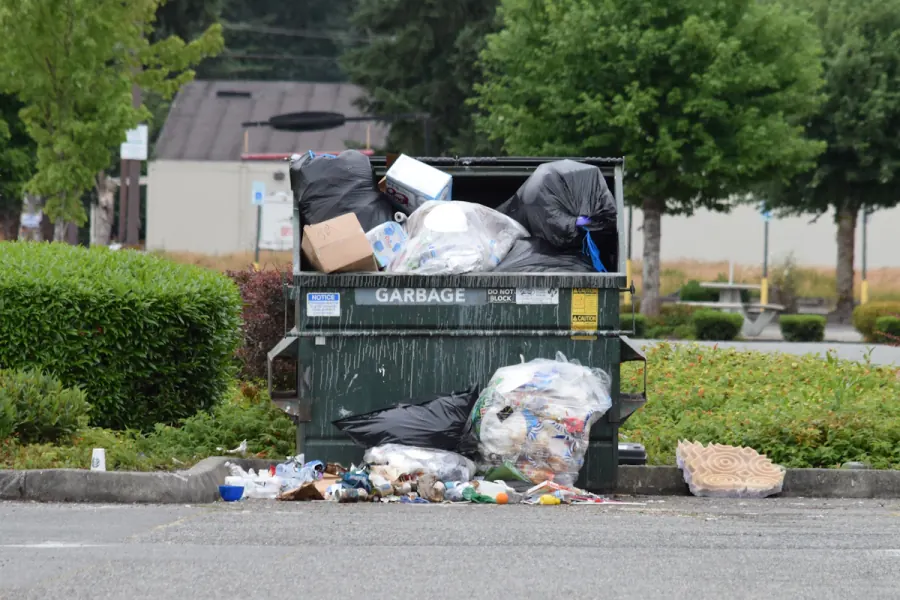
The commercial work we see most in Brownsville
Offices and professional premises
Office clearances are volume jobs. Desks, task chairs, filing cabinets, conference tables, shelving and cubicle systems occupy far more truck space disassembled than they do standing on a floor, which is the single most common underestimate in commercial quoting. Send a floor plan or a walkthrough video rather than a desk count, and budget for multiple loads on anything above a single room.
Retail and lease handovers
Retail work is deadline work. A lease normally requires the unit returned in a defined condition, which in practice means fixtures, shelving, signage and remaining stock out and the floor swept. Give us the handover date before the scope, ask for photographs and an inventory, and schedule out of trading hours if the unit is still operating.
Restaurants and commercial kitchens
Kitchen strip-outs combine three categories in one job: heavy stainless equipment, fit-out and millwork that counts as construction debris, and refrigeration units that carry the Freon rule. The City of Brownsville refuses any Freon appliance without a recovery decal from a certified facility, and a walk-in cooler is no exception. Handling for those is on appliance removal.
Warehouses and light industrial
Brownsville sits on a working border and freight corridor, with Los Tomates port of entry in Southmost and substantial industrial employment in the area, so warehouse and yard clearances are ordinary work here. Racking, pallets, damaged stock, strapping and scrap metal are the usual mix, and the scrap stream is worth separating rather than burying in a general load.
Property management
Managers running multiple units need a rolling arrangement rather than repeated one-off calls, since turnover is continuous. Those jobs overlap heavily with foreclosure and eviction cleanouts, including the written inventory and before and after photography that protects the manager in a dispute.
Contractors and active sites
A working jobsite generates debris on a schedule and benefits from scheduled hauling rather than emergency calls. Material specifics are covered on construction debris removal.
How a commercial job runs
- 1Send the scope and the constraint
Floor plan or walkthrough video, plus the real constraint: trading hours, a lease handover date, a loading dock restriction or a tenant in the next unit.
- 2Flat quote per load or per project
One-off jobs price per truckload. Multi-load clearances and recurring schedules are quoted as a project or a rate, not improvised per visit.
- 3Schedule around the business
Evening and early morning slots for retail and hospitality, weekday slots for offices and warehouses, recurring slots where volume is predictable.
- 4Separate the streams
Electronics, scrap metal, Freon appliances and general waste each go their own route. Data-bearing hardware is your responsibility to wipe before it leaves.
- 5Permitted disposal with a record
Material goes to a facility licensed to accept it, with the disposal point named and an inventory provided where the job calls for one.
Storm exposure is a commercial problem too
Businesses on the Texas coast carry the same hurricane exposure as households and usually with more at stake. Hurricane Hanna in July 2020 destroyed mobile homes, tore roofing off hundreds of buildings and caused flash flooding with numerous water rescues across Cameron and Hidalgo counties. Dolly hit in July 2008 at around 100 mph. Beulah made a Category 3 landfall near Brownsville on September 20, 1967 with a 15 to 20 foot surge.
For a commercial site, the useful preparation is clearing loose yard material and outdoor storage before June 1 rather than after a warning is issued. Post-storm handling is covered on hurricane debris cleanup.
Commercial coverage across the Valley
We work with businesses throughout Brownsville and across San Benito, Los Fresnos, Rancho Viejo, Harlingen, Port Isabel and eastern Hidalgo County including McAllen. Disposal routing differs by address, since Harlingen runs its own municipal transfer station and McAllen sits in Hidalgo County, but that is a logistics matter rather than a pricing one. Coverage is on the service area page, and you can start a commercial quote through the contact form.