Brownsville is a city that has actually been hit
Brownsville sits at the southern tip of the Texas Gulf Coast and has taken direct hurricane landfalls within living memory. Hurricane Beulah came ashore near Brownsville on September 20, 1967 as a Category 3, driving a storm surge of 15 to 20 feet. It killed 15 people in Texas, destroyed or heavily damaged roughly 3,000 homes and caused $217 million in 1967 damage, equivalent to about $1.59 billion in 2017 dollars.
The record since then is not quiet either. Hurricane Dolly struck in July 2008 with winds around 100 mph. Hurricane Alex came through in mid 2010. Hurricane Hanna made landfall in July 2020, destroying mobile homes, tearing roofing off hundreds of buildings and producing flash flooding with numerous water rescues across Cameron and Hidalgo counties. Atlantic hurricane season runs from June 1, and the preparation that matters happens before that date rather than after a warning is issued.
What storm debris cleanup costs
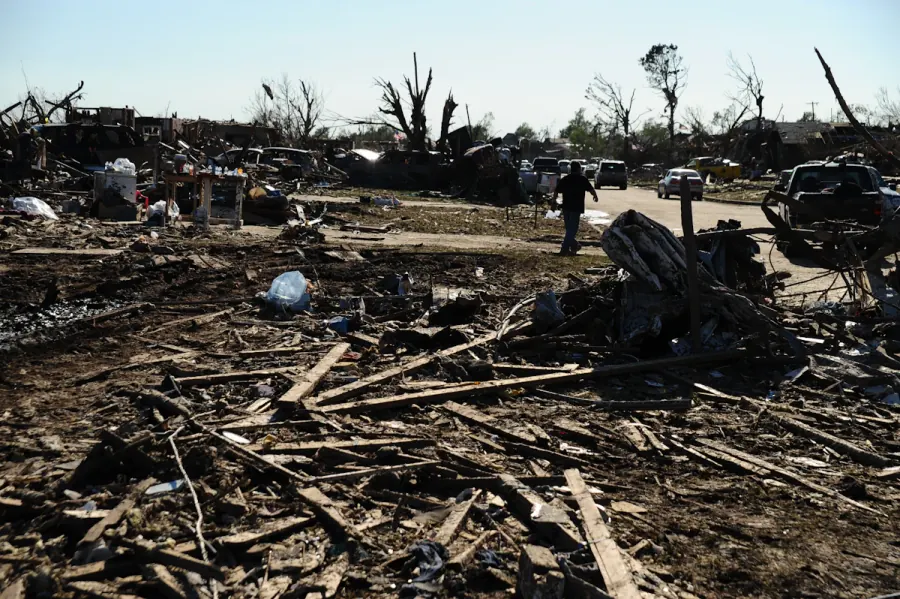
Storm debris hauling in Brownsville typically runs $350 to $850 per truckload, and most single-property cleanups take one to three loads. Storm material is bulky rather than dense, so it fills a truck faster than its weight suggests. A downed tree, a collapsed fence line and a yard of scattered material is routinely more volume than the homeowner estimated from the driveway.
| Debris type | Typical load | Typical price |
|---|---|---|
| Downed limbs and fronds | Half to full truck | $250 to $600 |
| Whole downed tree, already cut | One to two full loads | $450 to $850 per load |
| Collapsed wooden fence line | Half to full truck | $300 to $650 |
| Torn-off roofing shingles | Weight-limited load | $450 to $850 |
| Flood-soaked furniture and mattresses | One to two full loads | $400 to $850 per load |
| Whole-property storm cleanup | Two to four loads | $900 to $3,000 |
Bands follow volume pricing of roughly $1.50 per cubic foot with full-truck loads of $450 to $850, the published national junk removal rates; observed Brownsville-area job pricing has ranged from $102 to $612 for single loads. Roofing is weight-limited rather than volume-limited. Declared-event municipal collection, where it is activated, is free and should be used where it applies.
Where a declared-event collection is running and your material qualifies, that route is free and we will say so. Private hauling after a storm is for the gap: material outside the collection categories, properties on a deadline, and households who cannot wait for a city-wide pass to reach their street.
What the city does and does not do after a storm
The ordinary City of Brownsville brush and bulky program cannot absorb a hurricane. It runs on a four-sector rotation serving one sector per week, with material set out a week ahead of the sector's collection week, brush and bulky in separate piles, and six feet of clearance from gas and water meters, telephone boxes, overhead wires, parked cars and overhangs. That is a system built for routine volume on a predictable schedule.
After a declared event, collection arrangements normally change, and the instructions issued by the City of Brownsville and Cameron County emergency management supersede the normal program. Those instructions usually specify how to separate material, where to place it, and for how long collection will run. Follow them exactly, because misseparated piles are the most common reason storm debris gets left behind. The normal program is explained on the bulk and brush schedule page.
The 48-hour problem with flood-soaked contents
Porous material that has taken floodwater needs to leave the house fast, because mould establishes within roughly 24 to 48 hours in Gulf Coast heat and humidity. That applies to mattresses, upholstered furniture, carpet and pad, particleboard and laminate furniture, stored cardboard, books and paper. None of it dries out usefully in a Brownsville summer, and all of it holds whatever was in the water.
The practical tension is with insurance documentation. Photograph everything thoroughly before it moves, wide shots first then item close-ups, and check your carrier's requirements. Then get the saturated porous contents out. Leaving a soaked house sealed for a week waiting for an adjuster generally makes the claim worse, because the mould damage that follows is a second problem layered on the first. Mattress-specific handling is on mattress removal.
What comes off a Brownsville property after a storm
Vegetation
Downed limbs, whole trees, uprooted shrubs and the palm fronds that strip off in high wind are the largest volume category. We haul cut material; felling a leaning or damaged tree is arborist work and should be booked first. Ordinary vegetation handling is on yard waste and brush removal.
Fencing and outbuildings
Wooden fence lines fail routinely in a coastal county, and a collapsed fence becomes construction debris the moment it stops being a fence. Sheds, carports and patio covers behave the same way. Fasteners in this material are why it goes into a truck rather than onto a footpath in a neighbourhood where people walk.
Appliances and electronics
Flooded refrigerators, freezers, washers and window air conditioning units all come out, and the Freon rule still applies after a storm. The City of Brownsville will not collect a Freon-containing appliance without a recovery decal from a certified facility, and declared events typically require white goods in their own separate pile. Handling on appliance removal.
Household hazardous waste
Storms displace paint, fuel, pool chemicals, pesticides and car batteries, sometimes out of sheds and into yards. These are excluded from ordinary collection and from a standard junk load, and declared-event instructions generally give them their own category. Keep them separate and identified rather than mixed into a pile.
How a storm cleanup runs
- 1Photograph before anything moves
Document the damage for your insurer first. Wide shots of each affected area, then close-ups of individual items, before any clearing starts.
- 2Confirm the property is safe to work
No downed lines nearby, no standing water with unknown electrical status, no structure at risk of further collapse. Access has to be genuinely clear.
- 3Flat quote per load from photos
One number per truckload agreed before scheduling. Post-storm is exactly when pricing discipline matters most.
- 4Separate the streams as the city requires
Declared-event collection usually requires vegetation, construction debris, appliances, electronics and household hazardous waste in separate piles. Follow the current instructions.
- 5Haul the saturated contents out fast
Porous material that took floodwater goes first, because mould establishes within roughly 24 to 48 hours in Valley heat.
The cheapest storm cleanup is the one you prepared for
Clearing a yard before June 1 costs a fraction of clearing it afterwards, because loose material that would have become wind-driven debris never enters the equation. Dead palm fronds, stacked timber, an old shed, loose fencing, a disused trampoline and yard furniture are all projectiles at hurricane wind speeds, and they damage your property and your neighbours' before they become debris to haul.
The structural reason this cannot be left to the city calendar is that the four-sector rotation serves one sector a week. It cannot absorb an entire city clearing in late May. What to clear, and in what order, is set out on the pre-hurricane yard cleanup page.
Storm cleanup across Cameron County
We work throughout Brownsville and out across Los Fresnos, Rancho Viejo, San Benito, Harlingen, Port Isabel and eastern Hidalgo County. Coastal communities toward Port Isabel and the Queen Isabella Causeway take the surge and wind exposure first, while inland flooding tends to hit low-lying Brownsville neighbourhoods and the resaca margins. Coverage is on the service area page, and photos through the quote form get you a per-load number.